Chasing 0.1 BTC: How a Fleet Upgrade Rewrites the Calendar
A tenth of a bitcoin is a serious milestone for a small operation, and the wait depends almost entirely on fleet size. At 250 TH/s the division gives 0.00011215 BTC a day, so 0.1 BTC needs 891.7 days. Scale to 2.5 PH/s and the same prize arrives in 89.2 days, with the network at 1,003 EH/s and daily issuance of 450 BTC.
Key takeaways
- 250 TH/s banks 0.00011215 BTC daily, putting 0.1 BTC at 891.7 days out.
- 1 PH/s earns 0.00044861 BTC a day and reaches 0.1 BTC in 222.9 days.
- 2.5 PH/s credits about 0.00112153 BTC daily, compressing the goal to 89.2 days.
- Inputs are fixed at 21 Sept 2026: 1,003 EH/s, 132.76 T difficulty, BTC $84,692.
Why 0.1 BTC is the right planning milestone
Small goals mislead because fees and variance dominate them; large goals mislead because difficulty moves before they arrive. A tenth of a bitcoin sits in the useful middle for a growing farm: big enough that daily noise averages out, near enough that hardware bought today still matters when the target lands. At $84,692 per coin the milestone is worth $8,469, a figure a spreadsheet can hold without fantasy.
Calendar thinking also disciplines spending. An operator who knows the current fleet needs 891.7 days can price every upgrade in days saved rather than coins earned. A second batch of machines is not "more income" in the abstract; it is the difference between roughly thirty months and roughly fifteen. That framing keeps expansion discussions concrete when vendors pitch hardware on revenue multiples alone.
Four fleet sizes, one shrinking wait
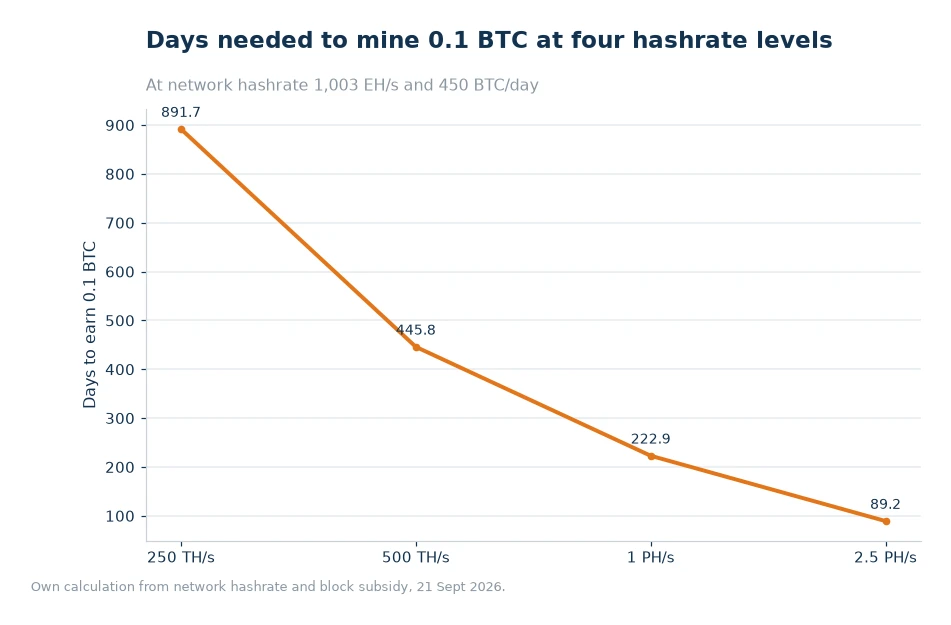
The curve below holds difficulty constant and varies only the fleet. From 891.7 days at 250 TH/s, the wait falls to 445.8 at 500 TH/s, then 222.9 at 1 PH/s, then 89.2 at 2.5 PH/s. Each doubling of hashrate halves the calendar because the daily slice doubles while the 0.1 BTC target stays put. Nothing else in the system behaves this linearly, which is why hashrate planning feels refreshingly honest.
Share-of-network numbers keep the scale humble. Even 2.5 PH/s is 0.000249% of 1,003 EH/s, a rounding error on the global ledger that still earns over a thousandth of a bitcoin daily. The network does not notice the upgrade; only the payout log does. That asymmetry is the quiet appeal of pooled mining at farm scale.
Calendar milestones also sharpen negotiations with suppliers. A vendor offering next-quarter delivery is not selling machines but selling a later start date, and the table prices that delay in days of 0.00112153 BTC. Ask for the delivery week in writing, convert the slip into lost daily credit at $94.99, and let the discount reflect the arithmetic.
Checking the pool picture before ordering hardware
Before signing for more machines, confirm the pool conditions the estimate assumes. The ViaBTC BTC Mining Pool view reports Pool Hashrate across coins alongside the Pool Luck record, and both repay a glance. Luck streaks do not alter PPS+ block-reward credits, which settle hourly against difficulty, but a falling Pool Hashrate can signal miners leaving for reasons worth understanding before you expand into the same market.
Settlement choice deserves a second look at this scale. PPS+ remains the default and suits operators who value predictable daily numbers for loan or power-bill planning. PPLNS carries a listed 2% on the combined reward and typically averages higher over long stretches, accepting variance along the way. A farm bridging toward 0.1 BTC on a deadline often prefers the predictable path; one with patient capital may prefer the cheaper combined fee.
Power contracts decide more than machine prices do
Hardware vendors quote dollars per terahash, but the power contract decides whether the fleet survives to the milestone. At roughly 20 joules per terahash, each PH/s draws on the order of 20 kW before cooling, so a 2.5 PH/s room needs industrial supply rather than spare outlets. Lock the tariff, the demand charge, and the curtailment terms before the machines ship, because electricity bought at the wrong hour can erase the margin the chart promises.
Cooling scales less gracefully than hashing. Two machines fit a fan and a window; twenty-five need ducted exhaust, dust filtration, and a summer plan for the hottest week of the year. Budget a full maintenance day per quarter per dozen machines: filter swaps, firmware checks, and thermal-paste inspections on aging boards. The calendar to 0.1 BTC assumes continuous uptime, and uptime is purchased with this unglamorous labor.
Staging the expansion instead of betting it
Few operators jump from 250 TH/s to 2.5 PH/s in one order, and the table suggests they should not have to. Moving first to 500 TH/s halves the wait to 445.8 days and teaches the power and heat lessons at half the stake. The next doubling to 1 PH/s brings 222.9 days, and only then does the final push to 2.5 PH/s make sense, with staff routines already proven.
The Profit Calculator turns each stage into dollars: enter the fleet size, current difficulty, and the listed fee split to see gross and net side by side. Re-run it whenever difficulty adjusts by more than a few percent. Staged buying plus recalculated expectations is how small farms reach large milestones without a single terrifying invoice.
| Fleet size | Share of 1,003 EH/s | Daily BTC | Days to 0.1 BTC |
|---|---|---|---|
| 250 TH/s | 0.0000249% | 0.00011215 | 891.7 |
| 500 TH/s | 0.0000499% | 0.00022430 | 445.8 |
| 1 PH/s | 0.0000997% | 0.00044861 | 222.9 |
| 2.5 PH/s | 0.000249% | 0.00112153 | 89.2 |
Read across any row and the story is identical: a microscopic network share converted into a concrete daily drip. The rightmost column is the one to tape above the desk, because it converts an abstract hashrate purchase into months of waiting. When the vendor quotes a price, divide by days saved and ask whether each rescued day is worth its cost.
Worked example
Rebuild the table from the network division, starting at the smallest fleet and ending at the largest.
- Daily BTC per TH/s: 450 ÷ 1,003,000,000 = 0.00000044865.
- 250 TH/s: 250 × 0.00000044865 = 0.00011215 BTC a day; 0.1 ÷ 0.00011215 = 891.7 days.
- Network share: 250 ÷ 1,003,000,000 = 0.000000249, or 0.0000249%.
- 500 TH/s: 500 × 0.00000044865 = 0.00022430 BTC a day; 0.1 ÷ 0.00022430 = 445.8 days.
- 1 PH/s is 1,000 TH/s: 1,000 × 0.00000044865 = 0.00044861 BTC a day; 0.1 ÷ 0.00044861 = 222.9 days.
- 2.5 PH/s is 2,500 TH/s: 2,500 × 0.00000044865 = 0.00112153 BTC a day; 0.1 ÷ 0.00112153 = 89.2 days.
- Dollar cross-check at the top tier: 0.00112153 × 84,692 = $94.99 a day before the listed fee slices.
- The listed 4% on the PPS-settled block reward and 2% on fees trim each row proportionally without changing the halving pattern.
Frequently asked questions
Is 0.1 BTC realistic for a 250 TH/s starter fleet?
It is realistic but slow: 891.7 days of continuous hashing at current difficulty, worth about $8,469 at $84,692. Most starters treat it as a background goal while planning the first upgrade.
Does Pool Luck affect how fast I reach the milestone?
Not under PPS+, which settles the block-reward slice hourly against difficulty regardless of Pool Luck. Pool Hashrate and Pool Luck still matter as health signals, and PPLNS miners do feel variance directly.
When should a farm switch from PPS+ to PPLNS?
Consider it once cash flow tolerates uneven weeks. PPLNS carries a listed 2% on the combined reward and fees, pays after 6 confirmations over the last 5 difficulty rounds, and usually averages higher across long horizons.
Buy days, not just terahash
Every purchase order in this market is secretly a calendar negotiation. Quote each candidate fleet in days to 0.1 BTC, attach the power contract that sustains it, and stage the doublings so operations knowledge arrives before the biggest invoice. The farm that reaches 89.2 days from 891.7 rarely does it in one leap; it does it in three calm ones.
Start the paperwork with the fee schedule open beside the hardware quote, confirming which slice each listed rate touches. Then the milestone stops being a dream and becomes a dated entry: hardware in, power on, 0.1 BTC expected in a counted number of mornings.
Sources: the ViaBTC fee and pool status pages for listed rates, Pool Hashrate and Pool Luck context, and setup guides[1]. Chain data read 21 Sept 2026: 1,003 EH/s, difficulty 132.76 T, 3.125 BTC per block, 144 blocks daily, BTC $84,692. Figures published 11 Nov 2026; timelines assume steady difficulty and full uptime.